
Automated Tasks
Automated Tasks in User Manager allow you to schedule and execute user management operations automatically, saving time and ensuring consistent user administration across your Atlassian environment.
What Are Automated Tasks?
Automated Tasks let you automate routine user management actions using saved filters from the User Browser. Instead of doing everything manually, you can set up recurring or one-off tasks that handle the heavy lifting for you.
Organization Administrators are automatically excluded from all automated task actions. This protection cannot be overridden.
What You Can Do with Automated Tasks
Automated Tasks combine saved user filters with bulk operations. You can use them to:
Schedule regular user cleanups or license reviews
Automatically apply policies to user groups
Reduce license costs by handling inactive users
Enforce security policies through recurring checks
Create both scheduled and on-demand task templates
Keep track of changes in detailed audit logs
Actions You Can Automate
An Automated Task can perform one or more of the following actions:
Add users to groups
Example: Move inactive users into a dedicated group for follow-upRemove users from groups
Example: Clean up access to project-specific groups after offboardingRestore User Access
Removes suspension status from users, allowing them to access Atlassian services againSuspend users
Example: Temporarily disable inactive or non-compliant usersRemove app access
Example: Reclaim licenses from users who haven’t used a product in months
Automated Tasks help you stay on top of user management without needing to monitor every change manually.
Key Benefits
Automation
Remove manual steps from recurring user management work.Consistency
Apply policies in a predictable and repeatable way.Scheduling Flexibility
Run tasks daily, weekly, or manually when needed.Audit Trail
Track what happened and when with full execution logs.
How It Works
Create a saved filter
Define your user selection in the User Browser.Create an automated task
Link the saved filter to a new task.Set the schedule
Run manually, on specific weekdays, or at a recurring interval.Define the actions
Choose what happens to the users, for example remove access or assign a group. Actions run in the order you select them.Monitor execution
Each run is logged, so you can review results anytime.
Sync Timing and Task Results
A sync can run at the same time as an automated task. Because tasks run on a schedule rather than when you are watching, review their results regularly.
Results Can Differ When a Sync Is Running
Users being synced can be skipped. If the task's saved filter checks inactivity, excluded apps or excluded groups, the app skips users whose data is still being synced at the moment the task collects its users. This avoids acting on data that is not yet settled. Tasks with other filters do not skip users. The task then finishes with a partially failed status, and the skipped users appear in the run results. This is a protection, not an error. The next scheduled run picks them up once their data has settled.
A sync can change which users your filter matches. Group changes made through SCIM, your identity provider, or directly at admin.atlassian.com change group membership. If such a change is applied while the task is running, the users acted on can differ from the set the saved filter showed when you created the task.
This is more likely in Continuous Sync mode, where syncs run approximately every 5 minutes.
To keep results predictable:
Check the run results of your scheduled tasks, in particular the skipped and failed counts
Schedule tasks so they do not overlap with known group changes from SCIM or other external sources
When you plan a large group change from an external source, let the sync finish before the next task run
For a time-critical change, run the task manually after a completed sync instead of waiting for the schedule
Common Use Cases
Group assignment
Add inactive users to a customer group to downgrade license usage.License optimization
Remove product access from users who haven’t logged in recently.Security compliance
Suspend and restore accounts with no recent activity in line with your security rules.Onboarding
Automatically assign new users to teams based on profile attributes or usage patterns.Security audit
Users suspended during a security audit should be restored once they complete the required compliance training
Prerequisites
Before you can create tasks:
At least one saved filter must exist in the User Browser
You should know your organization’s user management rules
Getting Started
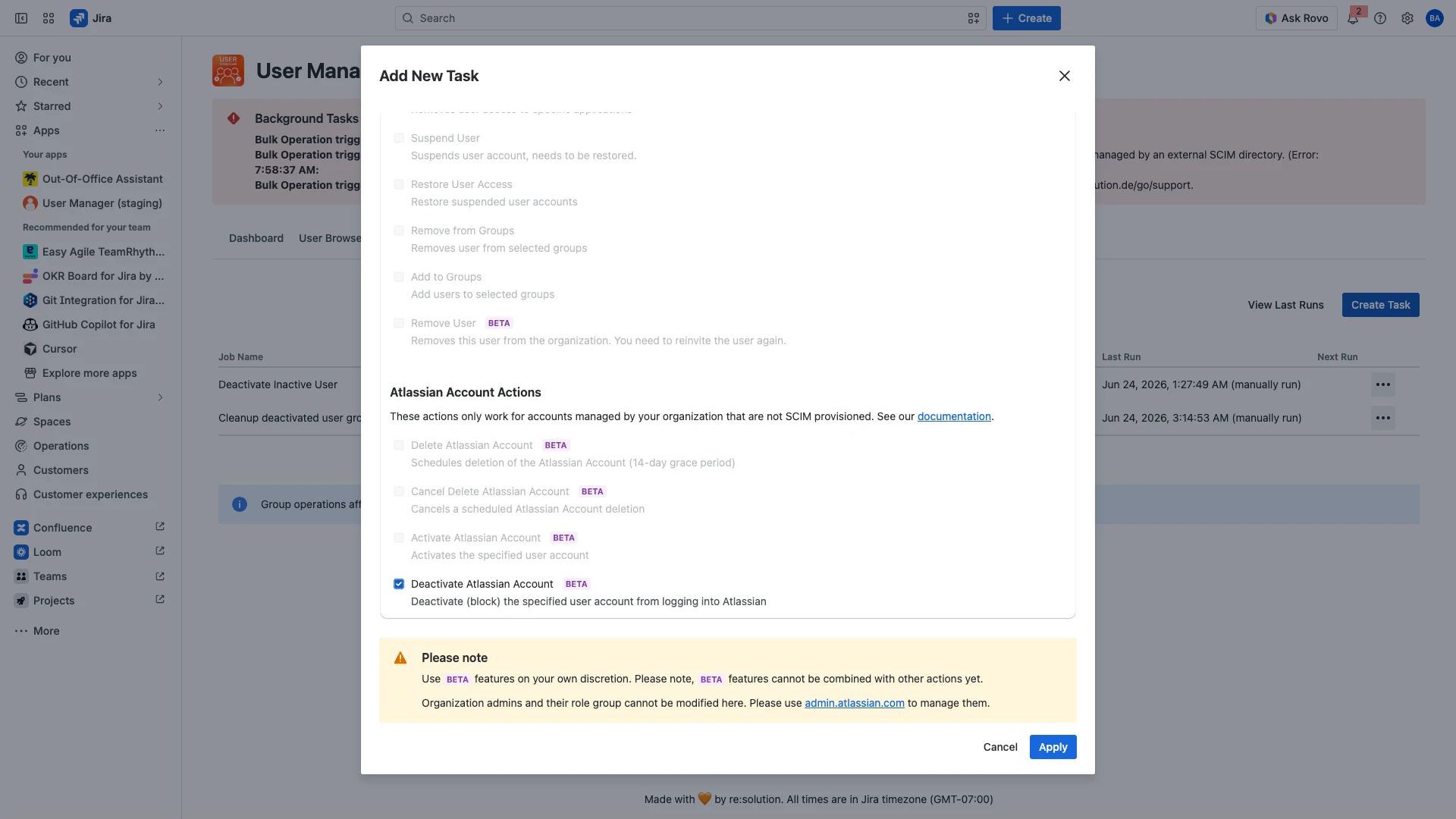
Go to Automated Tasks from the left navigation
Click Add New Task
Enter a task name and choose your saved filter
Set the schedule, then choose your actions
Once saved, the task is active and will follow your defined run plan.
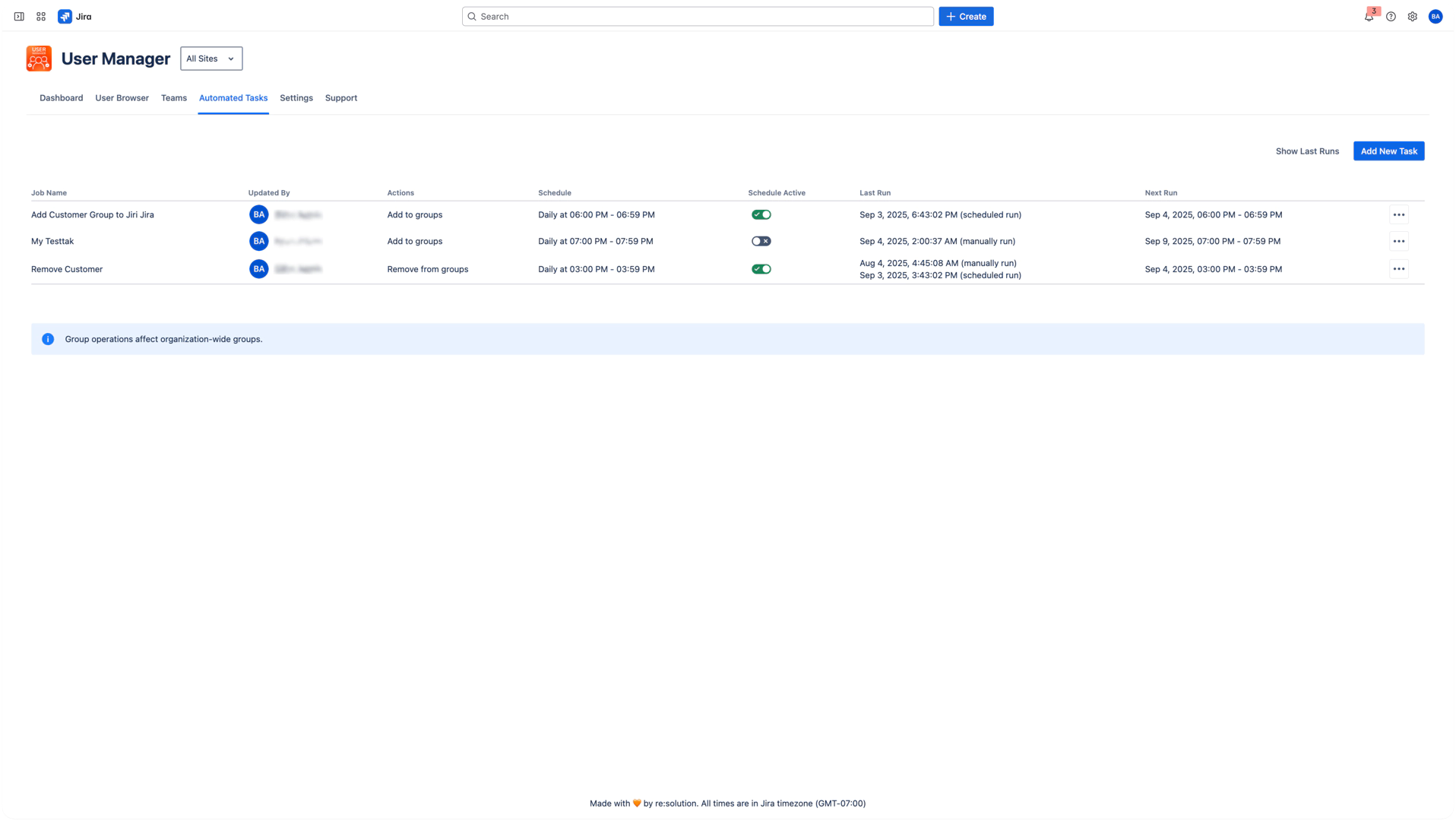
Lifecycle actions (beta)
Automated Tasks can run Atlassian account lifecycle actions - Deactivate, Activate, Delete, Cancel Delete, and Remove User - to schedule recurring cleanup of managed accounts.
These are beta features. The Atlassian platform does not yet expose a reliable signal for how a user was provisioned, so User Manager cannot automatically decide which actions are valid for each account before you run them. For now the action is attempted and any failure is surfaced in the process log: a blocked action returns a clear error and the user is left unchanged, so it never silently succeeds. Once Atlassian exposes a reliable provisioning-source signal, action selection will become smarter and actions that cannot succeed for an account type will be disabled before you run them.
For how to set up a task, see Creating Automated Tasks. For the full account-type behavior and how to read the results, see Performing Bulk Operations.