

Settings
The Settings page in User Management and License Optimizer provides centralized configuration options for your organization.
Overview
The Settings interface is organized into several key sections that allow you to configure how User Manager operates within your Atlassian Cloud environment. Each setting is designed to optimize user management workflows and ensure smooth synchronization across your organization.
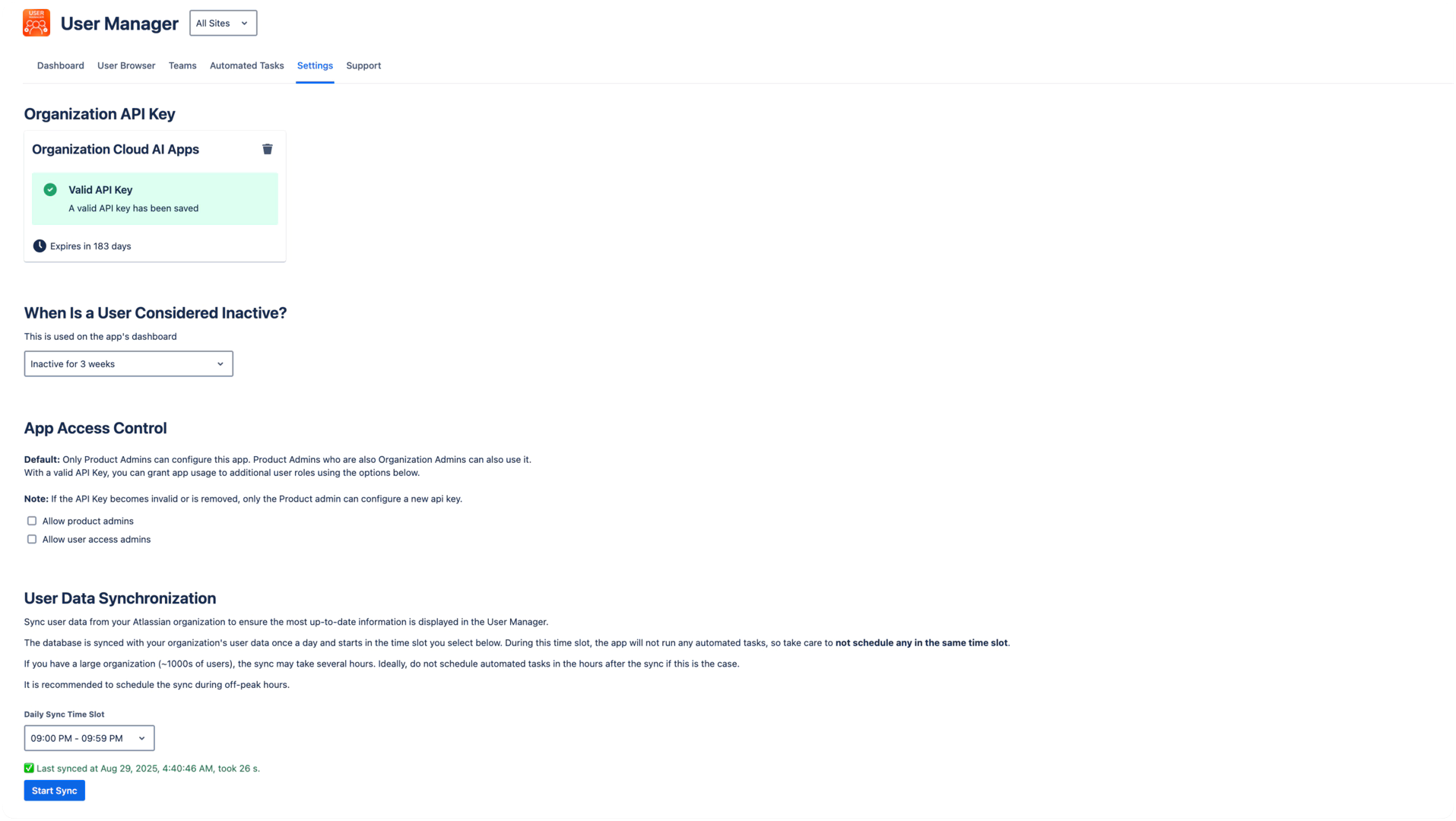
Key Configuration Areas
Organization API Key Management
View and manage your organization's API key
Monitor expiration dates for API access
Update with new API keys when needed
Dashboard Configuration
User Inactivity Thresholds: Define when users should be considered inactive
Options range from 3 days to 6 months.
This setting affects how users are displayed in the dashboard.
App Access Control
Grant additional administrators access to the User Management and License Optimizer App.
By default, only Organization Admins have access
Additional roles can be enabled:
Product Admins: Full access to all sites and actions
User Access Admins: Full access to all sites and actions (requires product access)
Important: When granting access to Product Admins or User Access Admins, they receive complete access to all sites, actions, and user data within User Manager. There are currently no in-app permission restrictions.
User Data Synchronization
The app maintains a local copy of your organization's user data in Forge SQL. This data is synced automatically once per day and can also be synced on demand.
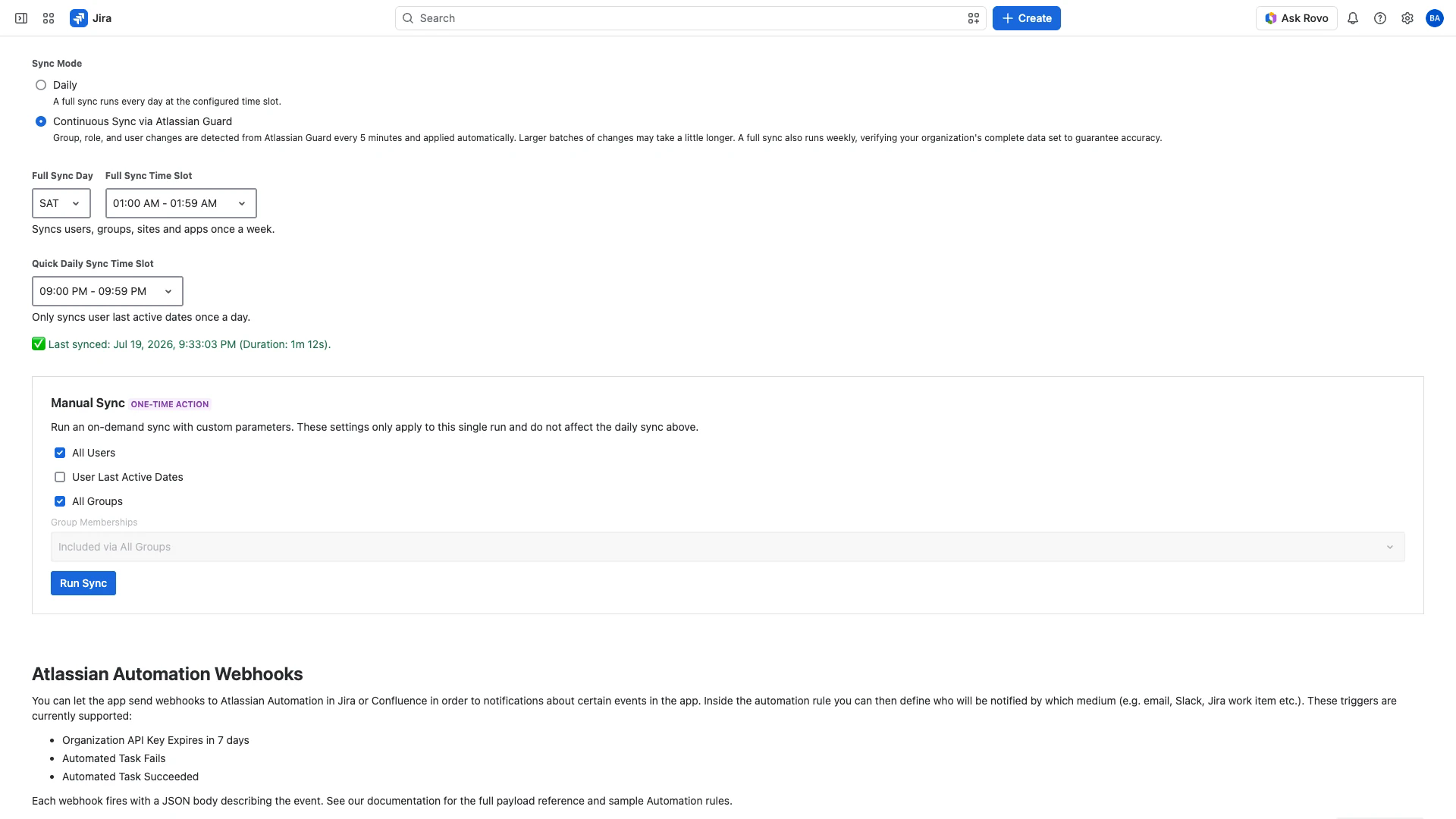
Sync Mode
Choose how User Manager refreshes its data from your Atlassian organization using the Sync Mode setting:
Daily - the default. A full sync runs every day at the configured time slot. See Daily Sync Schedule below for the time slot picker.
Continuous Sync via Atlassian Guard - group, role, and user changes are detected from Atlassian Guard every 5 minutes and applied automatically. Larger batches of changes may take a little longer. A full sync also runs weekly, verifying your organization's complete data set to guarantee accuracy.
Continuous Sync requires Atlassian Guard to be enabled on your organization. If Atlassian Guard is not enabled, only Daily mode is available.
For large organizations, Continuous Sync is recommended: near-real-time updates from Atlassian Guard keep user, group, and role changes current, while the weekly full sync guarantees complete accuracy without the overhead of a daily full sync.
Selecting Continuous Sync via Atlassian Guard reveals two additional fields:
Full Sync Day and Full Sync Time Slot - the day and hourly time slot for the weekly full sync. Syncs users, groups, sites and apps once a week.
Quick Daily Sync Time Slot - the hourly time slot for the daily quick sync. Only syncs user last active dates once a day.
For a deeper explanation of how each sync mode affects data freshness, see Sync and Data Freshness.
Daily Sync Schedule
Select a Daily Sync Time Slot (hourly slots, for example 05:00 AM - 05:59 AM).
Automated tasks and bulk operations can run during this time slot. While the sync is in progress, users whose data is still being synced can be skipped.
For large organizations (1,000+ users), the sync may take several hours. Avoid scheduling automated tasks in the hours after the sync.
Schedule the sync during off-peak hours.
Manual Sync
Run an on-demand sync with custom parameters. These settings apply only to this single run and do not affect the daily sync schedule.
Select one or more data types to sync:
All Users - Updates profile data for all users (name, email address, account status).
User Last Active Dates - Updates the last active timestamps for all users across all products. Use this before running reports or automated tasks based on inactivity filters.
All Groups - Updates all group definitions and their memberships. When selected, the Group Memberships field shows "Included via All Groups".
Group Memberships - When All Groups is unchecked, a group selector appears that lets you choose specific groups to sync. This is faster for targeted updates, for example after making changes to a specific product access group in your IdP.
Click Run Sync to start the manual sync.
A manual sync runs in addition to the daily scheduled sync. It does not reset or replace the daily sync schedule.
Statistics
The Statistics section provides a quick overview of your synced data:
Total users - The total number of user accounts synced from your organization.
Total groups - The total number of groups synced from your organization.
Member count by group - Select one or more groups from the dropdown to see how many members each group has. Use this to verify group sizes before running bulk operations or to check that SCIM-provisioned groups have the expected membership count.
Click Show to expand the Statistics section, and Hide to collapse it.
Atlassian Automation Integration
Configure webhooks for automation workflows
Available webhook triggers:
Organization API key expiring in 7 days
Automated task failures
Automated task successes
Integrate with Automation for Jira to create custom workflows
Remember to save
Changes on this page are not applied until you save each section.