

Find HubSpot Object and Link
Extended Use Case
Support issue linked to an existing Contact or Company
A customer emails support. A Jira work item is created via email integration or manually by Support.
The Contact already exists in HubSpot, but the Jira work item isn’t linked.
Without automation:
Sales cannot see development activity on the customer
CSMs have no visibility into technical blockers
Duplicate Contacts may be created
This rule searches HubSpot for an existing object (e.g., Contact by email, Company/Deal/Ticket by object name) and links the Jira work item to it.
This ensures the CRM record becomes the single source of truth for customer engagement.
About this rule
The keyword here is Find. This rule looks for a HubSpot object that already exists and links it to the work item. It never creates anything. If nothing matches, nothing is linked.
Video walkthrough
A short walkthrough of the Find HubSpot Object and Link rule, covering both the setup in the app and the flow in Jira.
Part one: inside the HubSpot for Jira app
Open the HubSpot for Jira Configuration, go to the Automation screen, and create a new automation rule.
Give your rule a name. Make it descriptive. You will need to find it again by name when you build the Jira flow, so make it easy to recognise.
Select that this is a Jira to HubSpot Automation.
Select the action, in this case Find HubSpot Object and Link.
Select the Jira space the rule should apply to.
Choose the HubSpot object type to look for: Contact, Company, Deal or Ticket.
Set up your identifier mapping. This is how the rule finds the right record, so it matters. Under Find the HubSpot <object> where these field values match, choose the Jira source field and the HubSpot unique field to match it against. The list offers the object’s default unique property – Email for Contact, and the object name for Company, Deal and Ticket – plus any HubSpot property marked as requiring unique values. See below.
Save the rule.
Choosing which HubSpot property the rule matches on
Every object type has a default unique property: Email for Contact, and the object name for Company, Deal and Ticket – Company Name, Deal Name and Ticket Name. The default is no longer the only choice.
Any HubSpot property can be offered to the rule by marking it as unique in HubSpot. When you create or edit a property, tick Require unique values for this property. HubSpot allows up to ten unique properties per object type.
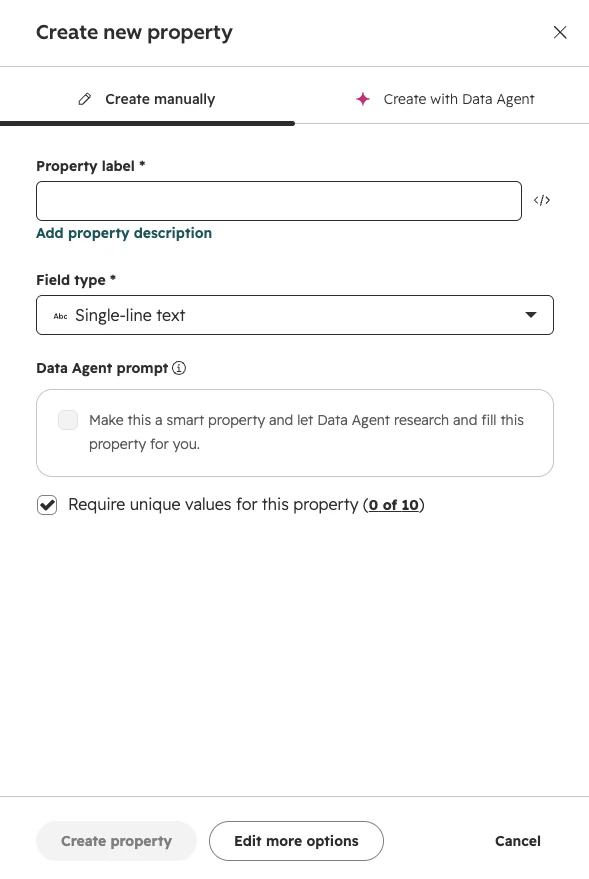
The property then appears in the rule’s HubSpot unique field list alongside the default. Under Find the HubSpot object where these field values match, choose the Jira source field to take the value from, and the HubSpot unique field to match it against.
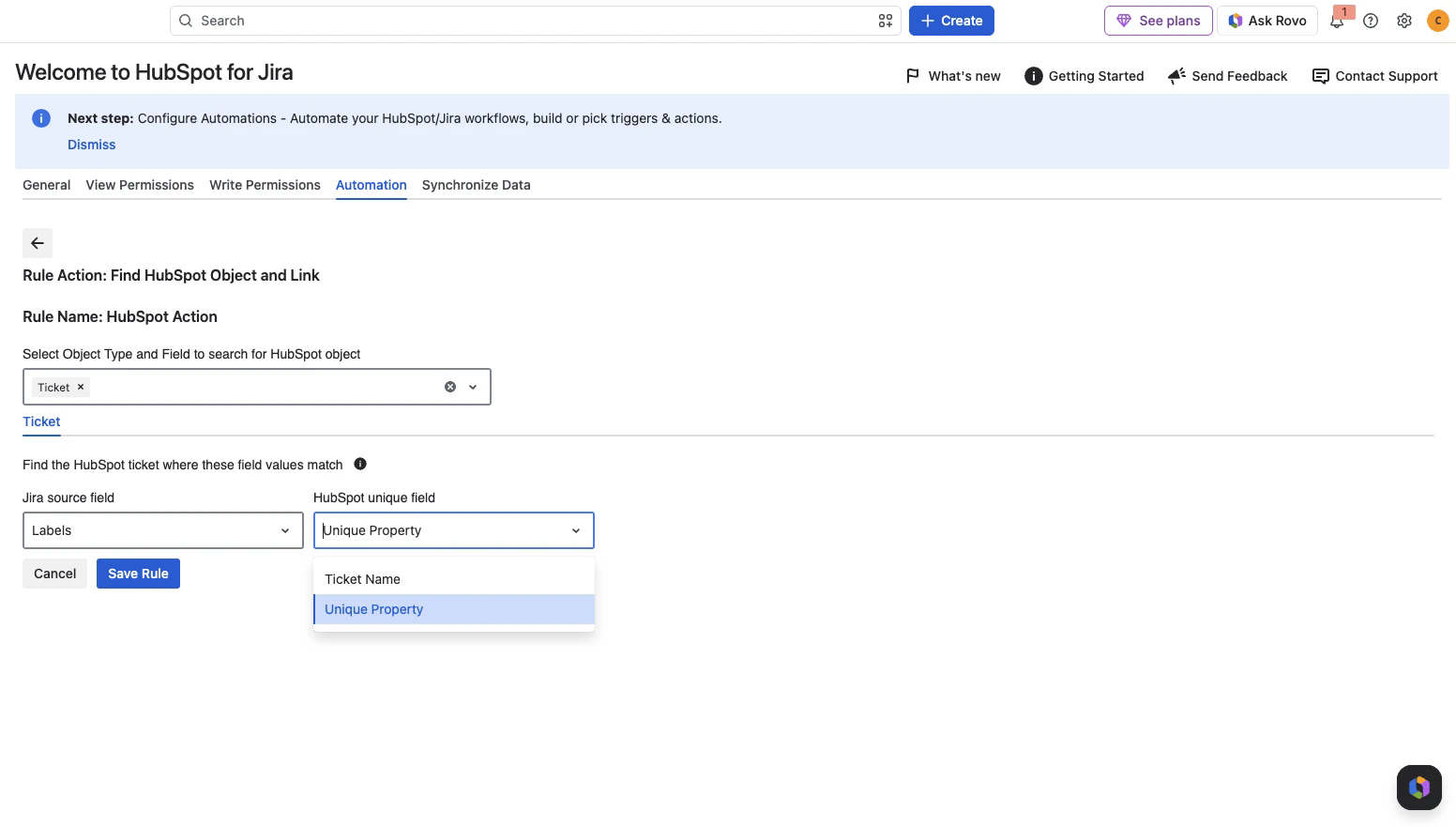
A property has to be marked unique in HubSpot before it appears here. If the property you expect is missing from the HubSpot unique field list, check that Require unique values for this property is ticked on the HubSpot side, then reopen the rule.
Part two: inside Jira Global Automation
Go to Jira Global Automation and create a new automation flow.
Pick your trigger, for example Work item created or Status changed.
Add an action and, from the list, find HubSpot CRM for Jira.
From the HubSpot CRM for Jira actions, choose Find HubSpot Object and Link.
Select the specific rule you just built, by the name you gave it earlier.
Save and enable your automation.
The first time you add a HubSpot CRM for Jira action on a site, Jira asks you to connect Atlassian Automation to the app. Select Connect and complete the prompt. Later flows reuse the same connection.
Outcome
The Jira work item appears on the Contact’s dashboard in HubSpot.
Sales can see open engineering work impacting their customer.
No duplicates are created.
Visibility improves without changing workflows.