

REST API Endpoints Documentation
The Out of Office REST API reads and writes out of office rules from outside Jira - from an HR system, a script, or a Jira automation rule. Every call carries a token created in the app.
Who can create a token
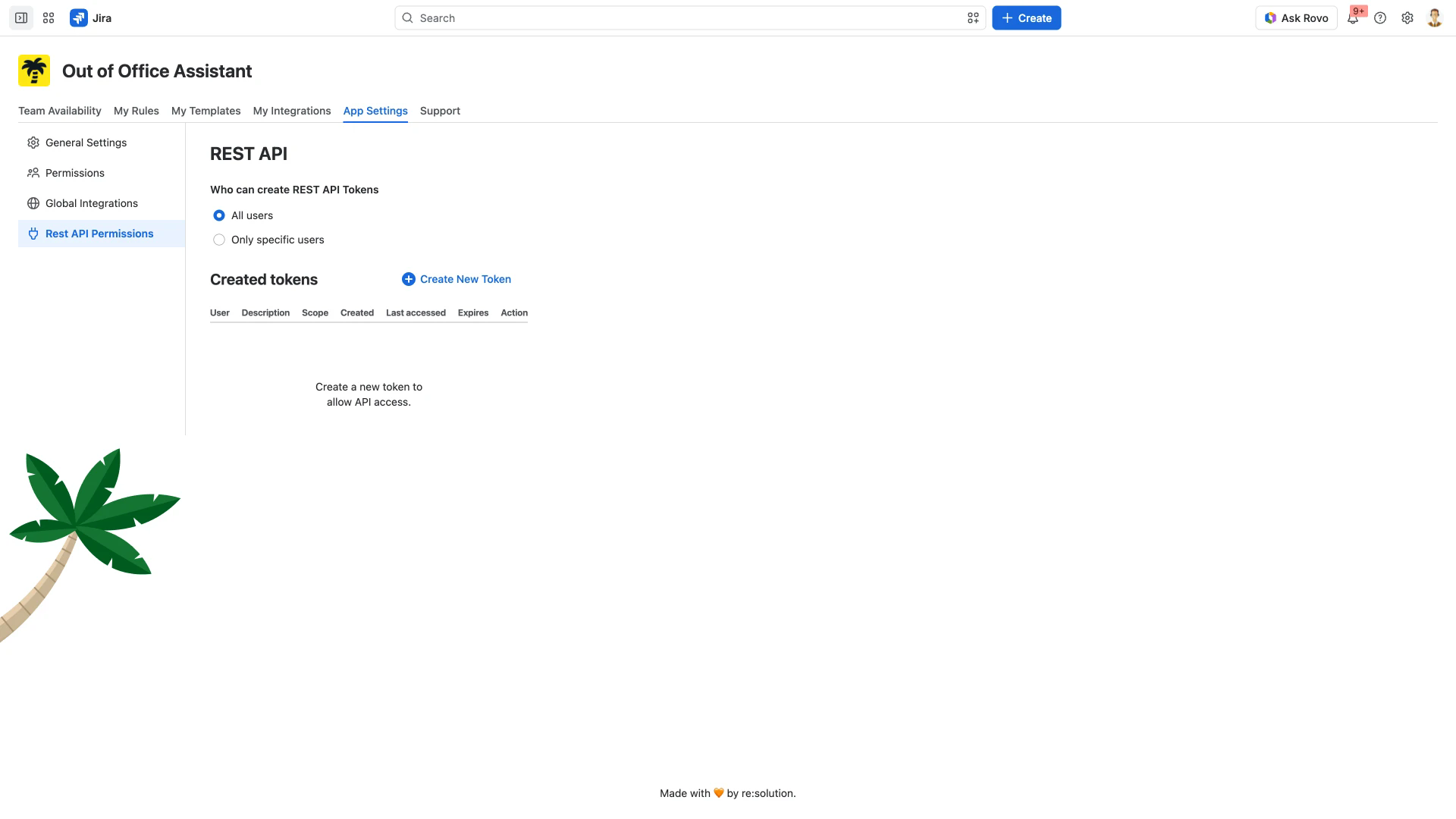
Token creation is controlled in App Settings > Rest API Permissions, under Who can create REST API Tokens. All users, the default, lets anyone using the app create one. Only specific users reveals two search fields, Specific users and Specific groups, and narrows token creation to whoever you add to them. There is no save button; a Saved marker confirms the change. Administrators reach the screen from App Settings; everyone else reaches the same list from My Integrations > REST API > Manage Tokens. Who counts as an administrator is set in Permissions and Access Requirements.
Create a token
Open App Settings > Rest API Permissions, or My Integrations > REST API > Manage Tokens.
Select Create New Token. The Create New API Token dialog has three fields and no user field, so you cannot issue a token in someone else's name; an integration needing other people's rules takes the ADMIN scope.
In Description, record what the token is for; it identifies the token in the list afterwards, so name the integration rather than the person. Generate Token stays disabled until this field has a value.
Choose a Scope. PERSONAL, the default, can read, create, update and delete only its owner's rules. ADMIN can manage rules for all users.
Choose when the token Expires. The dialog opens on 1 day.
Select Generate Token and copy the value straight into wherever the integration keeps its credentials.
The token value is shown once, when you generate it, and cannot be read back. A token whose value was not copied has to be replaced with Regenerate on its row.
Find your base URL
Each installation answers on its own REST base URL. The app does not display it, so ask for yours through Support > Contact us before pointing an integration at the API.
Endpoints
These are the endpoints the Connect version answered; only the base URL changed. Append the paths to it.
Path | Methods | Acts on |
|---|---|---|
| GET, POST, PUT, DELETE | The rules of the user who owns the token. |
| GET, POST, PUT, DELETE | The rules of the users named in the request. Requires an ADMIN token. |
Send the token as a bearer token in the Authorization header. Full request and response schemas are published in the API reference on SwaggerHub, whose server field still names the retired Connect host - use your own base URL instead.
Manage tokens you already have
Created tokens lists every token on the instance with its User, Description, Scope, Created, Last accessed and Expires values. Last accessed finds tokens nothing is using any more. Each row's action menu offers two things: Regenerate, which issues a new value and shows it once, and Delete.
If your instance came from the Connect version
Read Migrating from Connect to Forge first. It covers which tokens carry over, what happens to integrations you already run, and which address they talk to.