

Meeting Templates
NASA provides 11 pre-configured meeting templates that define the agenda structure, default questions, and recommended duration for a new meeting stream. Select a template during stream creation to start with a ready-made configuration, then customize it to fit your team's workflow.
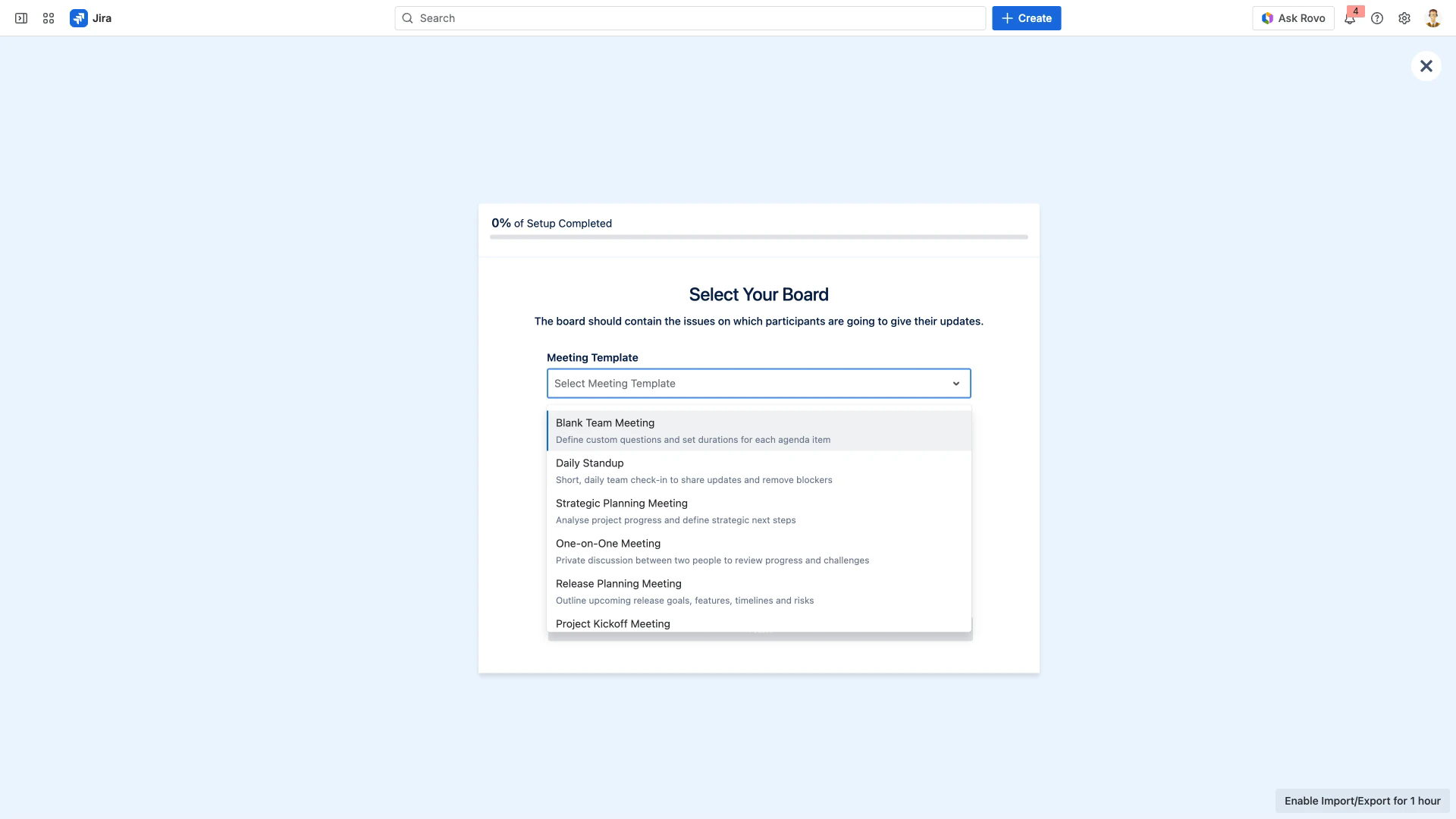
Template Overview
The following table lists every available template, its meeting type, and the default duration.
Template | Meeting Type | Default Duration |
|---|---|---|
Daily Standup | Standup | 15 minutes |
Strategic Planning | Team Meeting | 60 minutes |
One-on-One | Team Meeting | 45 minutes |
Release Planning | Team Meeting | 60 minutes |
Project Kickoff | Team Meeting | 60 minutes |
Sprint Retrospective | Team Meeting | 45 minutes |
Sprint Planning | Team Meeting | 60 minutes |
Sprint Review | Team Meeting | 60 minutes |
Backlog Refinement | Team Meeting | 60 minutes |
Brainstorming | Team Meeting | 60 minutes |
Blank Team Meeting | Team Meeting | Custom |
Daily Standup is the only Standup-type template. All other templates create Team Meeting streams. The Blank Team Meeting template starts with no pre-configured questions so you can define the agenda from scratch.
Template Details
Daily Standup
Short daily synchronization for team alignment.
Default questions:
What was done yesterday
What has to be done
Identify Blockers
Default duration: 15 minutes
Strategic Planning
Analyse project progress and define strategic next steps.
Default questions:
Explain the Topic (10 min)
Strengths Analysis (5 min)
Weakness Analysis (5 min)
Opportunity Analysis (5 min)
Threat Analysis (5 min)
Set Strategic Objectives (10 min)
Allocate Resources (10 min)
Define Key Performance Indicators (KPIs) (10 min)
Default duration: 60 minutes
One-on-One
Private discussion between two people to review progress and challenges.
Default questions:
Discuss Workload and Challenges (10 min)
Provide Personalized Feedback (10 min)
Define Future Goals (10 min)
Address Concerns (10 min)
Next Steps (First Things First) (5 min)
Default duration: 45 minutes
Release Planning
Outline upcoming release goals, features, timelines, and risks.
Default questions:
Define Release Goals (10 min)
Identify High-Priority Features (20 min)
Assign Timelines and Resources (20 min)
Risk Assessment (10 min)
Default duration: 60 minutes
Project Kickoff
Align the team on new project objectives and approach.
Default questions:
Define Project Objectives and Scope (10 min)
Introduce Team Members and Roles (10 min)
Outline Timelines and Milestones (30 min)
Communication Plan (5 min)
Q&A Session (5 min)
Default duration: 60 minutes
Sprint Retrospective
Reflect on the previous sprint to identify what went well and what can improve.
Default questions:
What Went Well (15 min)
What Didn't Go Well (15 min)
Improvement Actions (10 min)
Finalize Action Items (5 min)
Default duration: 45 minutes
Sprint Planning
Define sprint goals, tasks, and priorities for the next iteration.
Default questions:
Review Product Backlog (5 min)
Select User Stories for Sprint (10 min)
Break Down Stories into Tasks (30 min)
Estimate Effort and Assign Responsibilities (10 min)
Set Sprint Goals (5 min)
Default duration: 60 minutes
Sprint Review
Demonstrate completed work to stakeholders and collect feedback.
Default questions:
Demonstrate Completed Work (30 min)
Collect Stakeholder Feedback (15 min)
Update Product Backlog (15 min)
Default duration: 60 minutes
Backlog Refinement
Prioritize and clarify backlog items to improve sprint readiness.
Default questions:
Review Backlog Items (15 min)
Clarify Requirements and Acceptance Criteria (15 min)
Estimate Story Points (15 min)
Prioritize and Reorder Items (15 min)
Default duration: 60 minutes
Brainstorming
Generate creative ideas and solutions collaboratively.
Default questions:
Define Problem / Opportunity / Goal (10 min)
Brainstorm the Ideas (30 min)
Discuss and Refine Ideas (15 min)
Prioritize Actionable Items (5 min)
Default duration: 60 minutes
Blank Team Meeting
Start with an empty agenda and define custom questions with individual time allocations. Use this template when none of the pre-configured templates match your meeting format.
Selecting a Template
To create a new stream with a template:
Open the NASA app from the Jira sidebar.
Click Add New Stream in the left navigation.
On the first wizard screen, select a template from the Meeting Template dropdown.
Choose a Jira board for the stream.
Review and customize the pre-loaded questions.
Configure participants and schedule.
Save to create the stream.
Changing the Template on an Existing Stream
To apply a different template to an existing stream:
Navigate to the stream's Settings tab.
Open the General section.
Select a new template from the template dropdown.
Confirm the change. This replaces the current questions and updates the stream name.
Save changes.
You cannot convert an existing stream between Standup and Team Meeting types. To switch types, create a new stream with the desired template.
Customizing After Selection
Every template is a starting point. After selecting a template, you can customize:
Questions - add, edit, remove, or reorder using drag-and-drop
Time allocations - adjust the duration for each question
Participants - configure who can update during meetings
Schedule - set meeting days, time, and recurrence interval
Related Pages
Meeting Types - differences between Standup and Team Meeting formats
Stream-Based Workflow - how streams organize the meeting lifecycle
Getting Started - step-by-step guide to creating your first stream
General - stream-level settings including template selection
Meeting Settings - overview of all settings categories