

General
The General tab contains the core configuration for a meeting stream: template selection, board assignment, meeting questions, suggested issues, context fields, meeting settings, Team Journal export, and stream logo. Each section is an expandable accordion.
Meeting Template
Select or change the meeting template for this stream. Templates provide pre-configured questions and settings optimized for different meeting types. 11 templates are available, including Daily Standup, Sprint Planning, Sprint Review, Sprint Retrospective, One-on-One, Brainstorming, Project Kickoff, and more.

When you change templates:
Meeting questions are updated to match the new template
The stream name may update if it still uses the default naming
Time settings remain unchanged
Existing meeting data is preserved
Changing templates does not affect past meeting data. Save changes after selecting a new template.
Meeting Board
Select the Jira board linked to this stream. The board determines which issues appear in Suggested Issues and feeds the stream-based workflow. Both Scrum and Kanban boards are supported. For JSM projects, use a Kanban board created from a saved filter.
Name of Meeting Stream
Set a recognizable name for the stream. The default name combines the board name and template name (for example, "NASA board Daily Standup"). Change it to something meaningful for your team.
Meeting Questions
Define the questions or agenda topics that participants answer during meeting preparation. Each question becomes a section in the My Update form.

You can:
Edit existing questions by clicking the text field
Add new questions using the Add Question button
Reorder questions by dragging them
Delete questions by removing the text and confirming
Suggested Issues
Configure which Jira issues from the linked board appear as suggestions during meeting preparation. You can rename the section label (default: "Suggested Issues") and choose one filter method:

Priority - filter by one or more priority levels (for example, Highest, High)
Issue Type - filter by issue type (for example, Bug, Story)
Status - filter by workflow status
By Jira Issue Filter - use a saved Jira filter for full control via JQL
For details on each filter method, see Suggested Jira Issue Selection.
Context Fields
Display up to 2 additional Jira fields per project and issue type during meetings. Context fields appear as badges on issue cards in both preparation and live meeting views.

Supported field types include system fields (Project, Resolution, Due Date, Start Date, Parent/Epic, Components, Versions, Labels) and custom fields (text, numbers, dates, labels). Text, URL, and numeric fields are editable during meetings; all others are read-only.
Click Add Field to configure a new context field mapping. For full documentation, see Context Fields.
Meeting Settings
This section contains three options:

Enable Preview in My Update - when enabled, participants can see what others have already submitted in their My Update before the meeting starts. Available for Team Meetings only.
Make Stream Private - when enabled, only team members (Scrum Masters, Coverers, and Participants) can see this stream in the Streams Overview. Non-members cannot discover or access it. See Stream Privacy for details.
Meeting Link - optionally add a video meeting URL (Zoom, Google Meet, or other platform). This link is displayed in the meeting lobby so participants can join the video call before the meeting starts.
Team Journal Export to Confluence
Configure automatic export of Team Journal entries to Confluence. Two export modes are available:
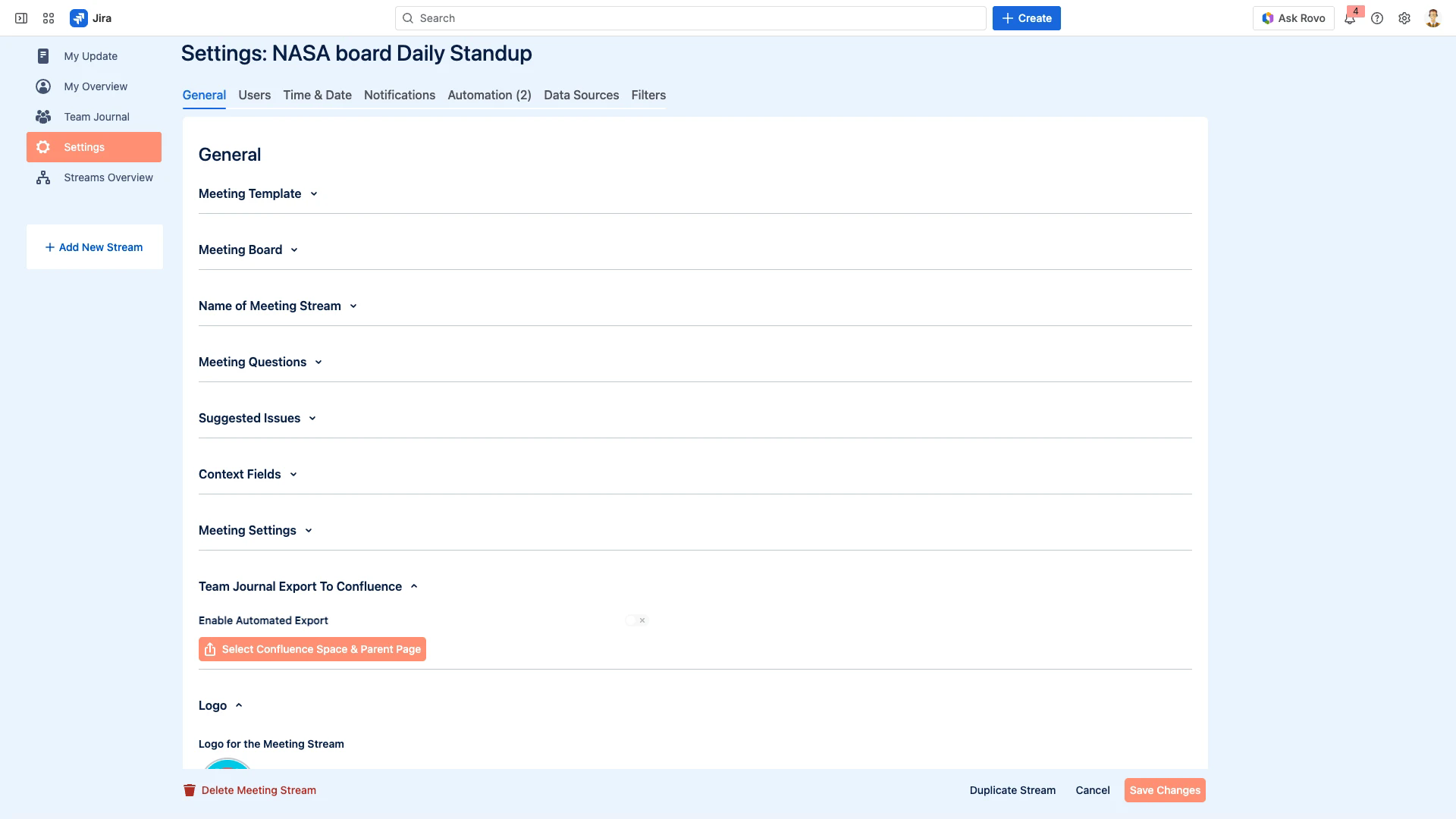
Automatic Export - enable the toggle and select a Confluence space and parent page. Every new Team Journal entry is exported automatically after each meeting ends.
Manual Export - when automatic export is disabled, users can still export individual journal entries from the Team Journal screen on demand.
Click Select Confluence Space & Parent Page to choose the export destination. The Confluence connection must be configured in the Data Sources tab first.
Logo
Upload a custom logo for the meeting stream. The logo appears in the stream selector dropdown and helps distinguish streams visually. Click Change Logo to upload a new image.
Duplicate Stream and Delete Stream
At the bottom of the General tab, two stream management actions are available:
Duplicate Stream - creates a copy of the current stream with all settings (name, board, questions, suggested issues, context fields, meeting settings, logo). Optionally includes users, filters, and automations. Only Scrum Masters and Coverers can duplicate. See Duplicate Streams for details.
Delete Meeting Stream - permanently removes the stream and all its meeting history, including Team Journal entries. Only Scrum Masters can delete streams. This action cannot be undone.
Remember to save
Click Save Changes at the bottom of the page after modifying any settings. Unsaved changes are lost when navigating away.