

Core Concepts and Navigation
NASA organizes meetings around three core concepts: Streams, Roles, and a three-phase meeting flow (Prepare, Meet, Document). This page introduces each concept and links to detailed documentation.
Streams
A Stream is a recurring meeting tied to a Jira board. Each stream has its own participants, roles, schedule, questions, and meeting history. You can belong to multiple streams with different roles in each.
Stream types cannot be converted
You cannot convert an existing stream between Standup and Team Meeting types. Create a new stream with the correct meeting type instead.
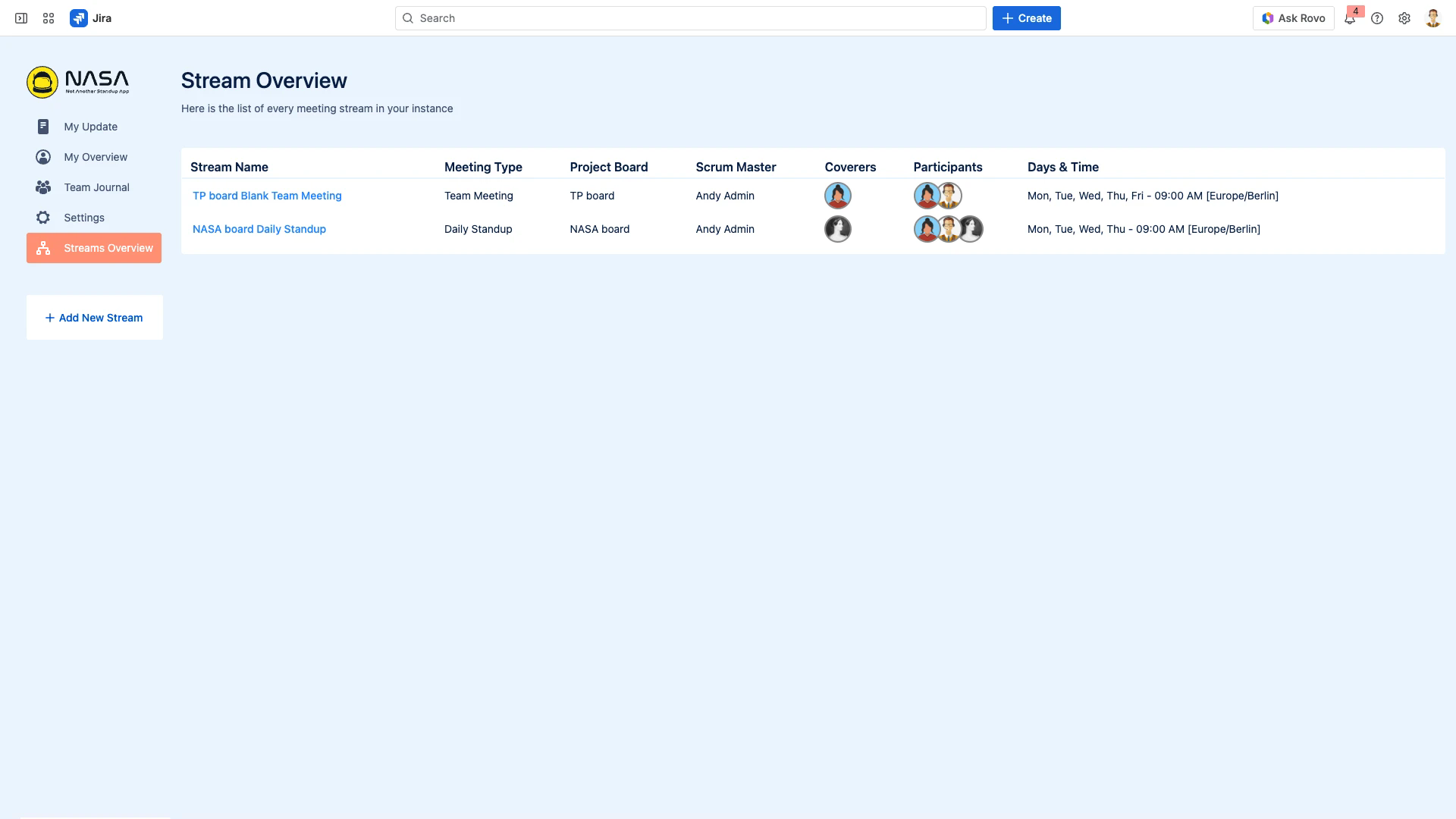
NASA supports two meeting types per stream:
Standup | Team Meeting | |
|---|---|---|
Purpose | Quick daily status updates | In-depth topic-based discussions |
Duration | 10-15 minutes | 30+ minutes |
Structure | Per-person updates | Topic-based agenda |
Timer | Per user or total meeting | Per agenda topic |
Item creation during meeting | No | Yes (Scrum Master/Coverer only) |
Planning Poker | No | Yes |
For details on creating and managing streams, see Meeting Streams.
Roles
Each stream assigns one of three roles to every participant:
Role | Key Permissions |
|---|---|
Scrum Master | Create/delete streams, start/end meetings, configure all settings |
Coverer | Same as Scrum Master except cannot delete the stream |
Participant | Prepare updates, attend meetings, react with emojis |
Roles are set per stream - a user can be Scrum Master in one stream and Participant in another. Roles cannot be changed during a live meeting.
For the full permissions matrix, see User Roles & Permissions.
Three-Phase Meeting Flow
Every meeting follows the same cycle:
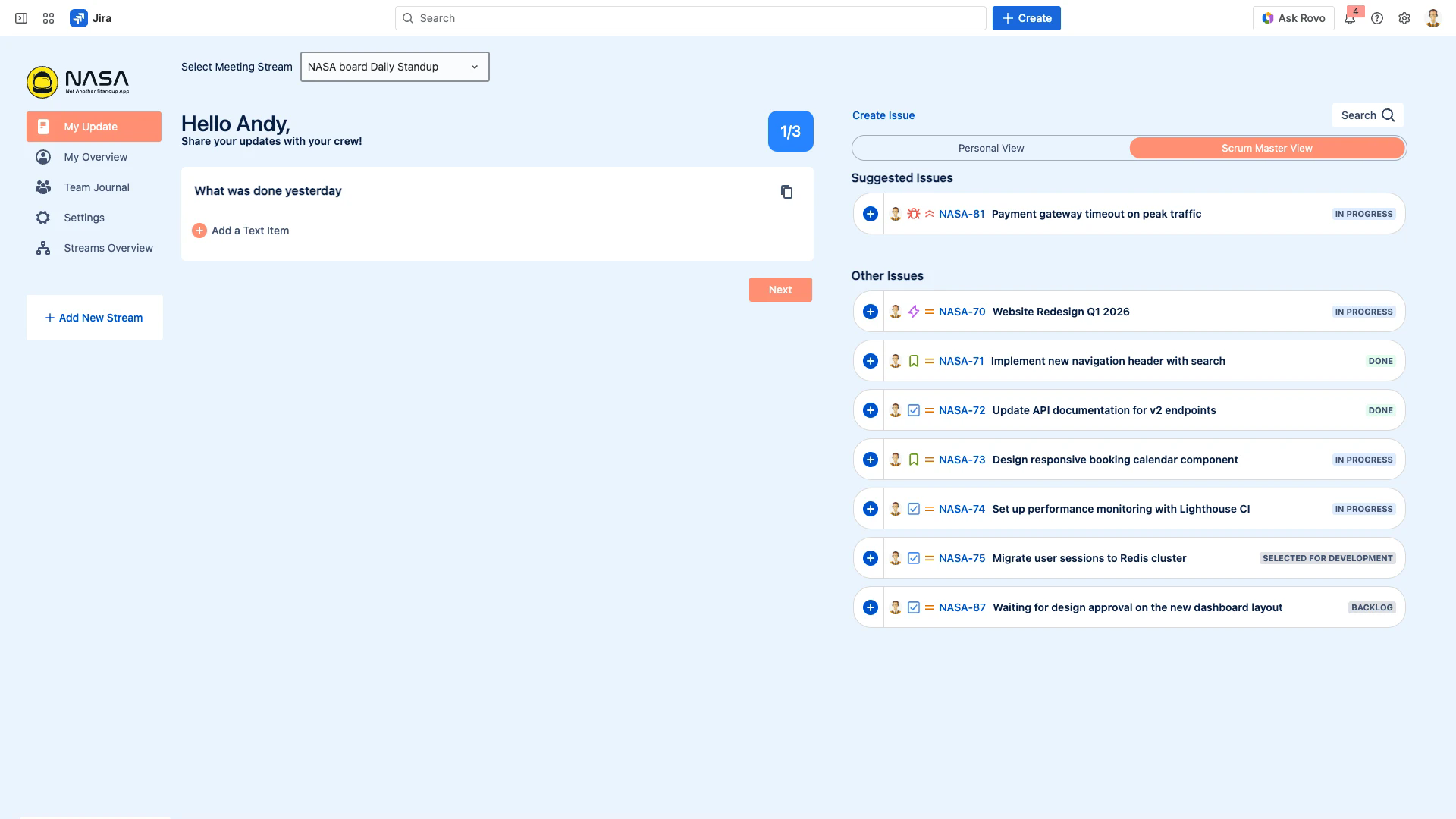
Prepare (My Update) - Add Jira issues, Confluence pages, text items, and answer structured questions before the meeting starts.
Meet (Live Meeting) - Join the lobby, run through the agenda with timers, flag follow-up items, react with emojis, and create issues on the fly (Team Meetings only).
Document (Team Journal) - The app automatically records the final meeting state. Browse past meetings, view statistics, and export to Confluence.
Settings
Stream settings are organized into 7 tabs: General, Users, Time & Date, Notifications, Automation, Data Sources, and Filters. Scrum Masters and Coverers can access all settings tabs. Participants can view Data Sources and Filters.
For details on each settings tab, see Meeting Settings.
Navigation
NASA is accessed via the Jira sidebar under Apps > NASA - Not Another Standup App. The app interface has two navigation elements:
Sidebar (left): My Update, My Overview, Team Journal, Settings, Streams Overview
Stream selector (top): Dropdown to switch between streams
For a visual walkthrough of every screen, see NASA Interface.
Documentation Map
Page | Description |
|---|---|
What streams are, how to create and manage them | |
Permissions matrix for Scrum Master, Coverer, and Participant | |
Visual reference for every screen in the app | |
Standup vs. Team Meeting differences | |
11 pre-configured templates for common ceremonies | |
All 7 settings tabs explained | |
Step-by-step first-time setup tutorial | |
Stream-Based Workflow, Planning Poker, Context Fields, and more | |
Scrum Master Guide and Participant Guide |
Related Pages
Getting Started - First-time setup and orientation
Meeting Types - Standup vs Team Meeting comparison
User Roles & Permissions - Scrum Master, Coverer, and Participant roles
Meeting Settings - Configure stream settings