

Issue Assignment and Watcher Management
While an Out of Office rule is running, the app hands each work item in the rule's scope that is assigned to you, or created with you as assignee, to the people named on it as coverers, and it can post a comment on each work item naming who has taken over. Work items you already hold when the absence starts stay with you. This page describes what happens to a work item at that moment.
Which coverer receives a work item
With a single coverer, every work item the rule acts on goes to that person. With several coverers, each work item goes to the coverer who has received the fewest work items from this rule so far, so the absence is shared rather than landing on whoever comes first in the list.
If that coverer cannot be given the work item, for example because they have no access to its space, the app tries the next coverer instead of failing the handover. If a coverer is out of office as well, the app passes the work item on to that person's own coverers, up to 5 steps along the chain. If the chain ends at someone who is away with no coverer of their own, or leads back to someone already in it, the work item stays with you and appears under Failures in the Reassignment Log.
Unassigned can be picked in the Coverers field alongside the people. Choose it and the work items the rule acts on are left with no assignee for the absence, which suits a queue that is triaged from a filter rather than owned by one person.
For adding, changing and removing the coverers on a rule, see Coverer Setup and Management.
The comment posted on reassignment
Enter text in Message Text on the rule and the app comments once on each work item the rule reassigns.
The app builds that comment from your text together with the original assignee, the coverer who has taken over and the absence period. The coverer's name is appended for you, so your own text does not need to name them.
Directly under the text area sits Share this message with service desk customers. Leave it clear and the comment stays internal to agents. Tick it and the customer who raised the Jira Service Management request sees the comment in the portal as well. What a portal customer sees is covered in Service Desk Customer Notifications.
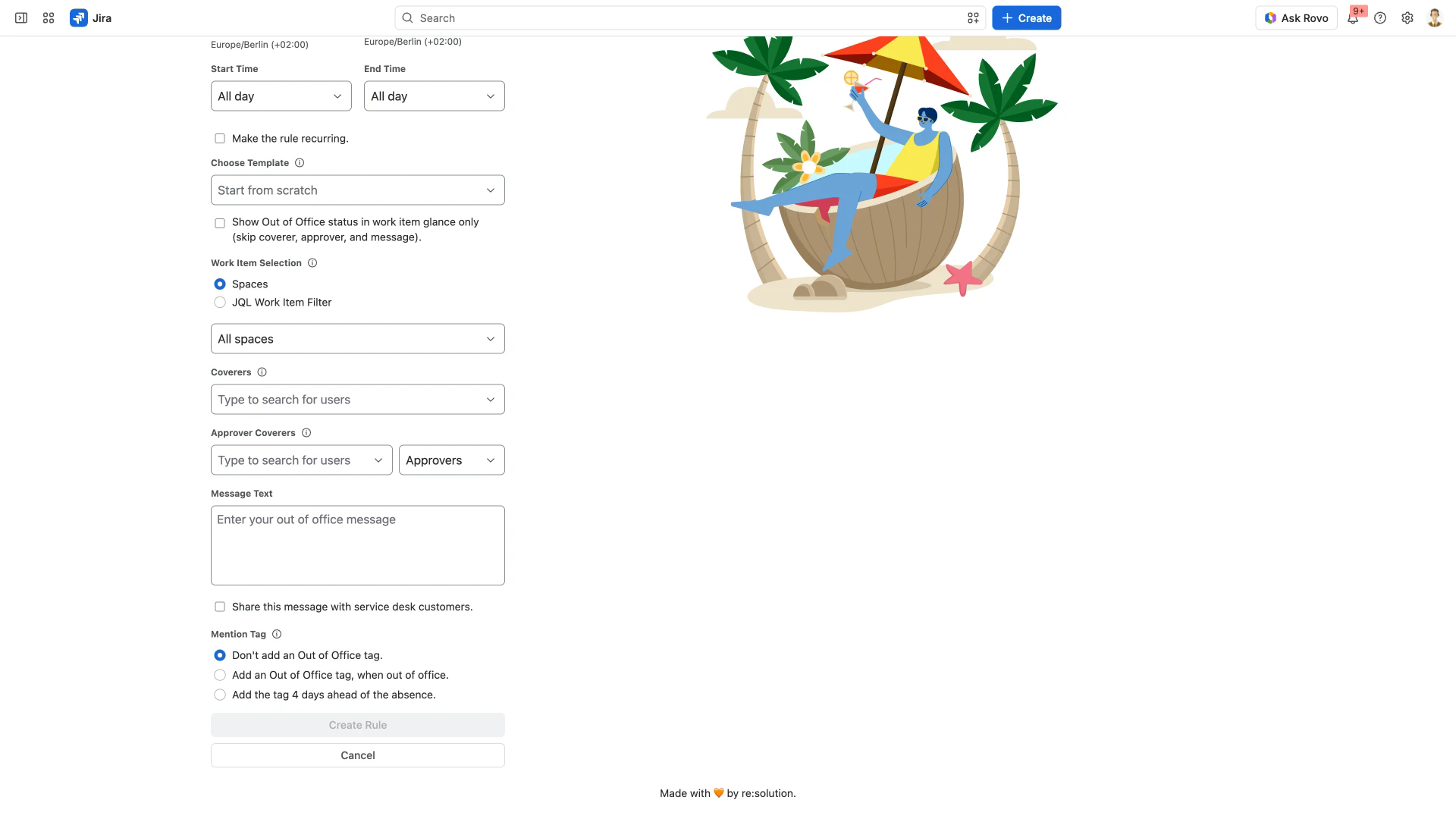
Message Text and the service desk sharing checkbox on the rule form. The Mention Tag options below them control the lozenge next to @-mentions, not this comment.
Rules that carry a message show an icon in the Message column of My Rules, so you can see which of your rules will comment before they start.
A rule's space or JQL scope decides which work items are reassigned and commented on. It does not change whether you count as out of office - your status applies to you as a person. See Rule Configuration Guide.
Watchers and work you already hold
An active rule acts on the assignee of a work item. Adding the coverers as watchers instead is offered by Bulk assign, which you start from a rule's Actions menu in My Rules. The same run lists the open work items already assigned to you inside the rule's scope, so the backlog you are holding when the absence starts can be handed over in one step. The dialog offers two choices: assign those work items to your coverers, or add the coverers as watchers and leave the assignee alone. See Bulk Assign.
Checking what a rule reassigned
Each rule's Reassignments column in My Rules carries a button reading, for example, 8 of 8 passed. It opens the Reassignment Log, which lists the work items that reached a coverer under Reassignments and the ones the app could not hand over under Failures, each with the trigger that caused it.
The same dialog is where you take work items back once the rule expires or is paused, described in Reclaiming Reassigned Issues.
Related pages
Coverer Setup and Management - choosing who covers for you
Bulk Assign - handing over the work items you already hold
Reclaiming Reassigned Issues - taking work back when you return
Service Desk Customer Notifications - what portal customers see
Mention Detection and Auto-Reply - the tag added next to @-mentions of absent users